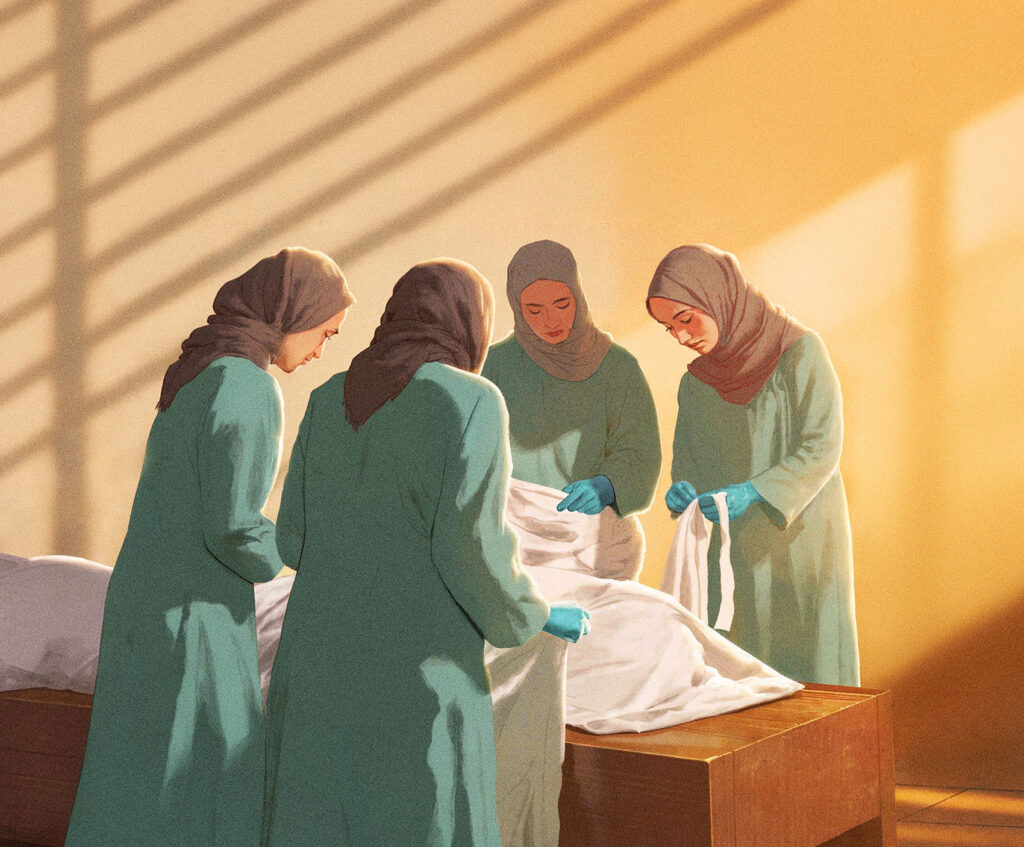
The Women Who Wash Our Dead
Listen on
Episode Credits
Suggested Reading
Abdelaziz, Rowaida. “Most Funeral Homes Don’t Know How To Bury Muslims. These Women Want To Change That.” HuffPost, December 10, 2023.
Bakar, Faima. “Why Young Muslim Women Are Learning How To Wash The Dead.” HuffPost UK, June 2022.
Halevi, Leor. Muhammad’s Grave: Death Rites and the Making of Islamic Society. New York: Columbia University Press, 2007.
Transcript
SOHAIRA SIDDIQUI
When I was studying Islamic law, I learned about this distinction early on. As a Muslim, there’re basically two kinds of obligations you have to live with.
There are obligations that are fard ‘ayn. Personal duties. The things each of us is individually responsible for: our prayers, our fasting, our zakat. If you neglect them, you’re personally accountable.
But then there are obligations that are fard kifaya. The communal responsibilities. Now these duties, as long as someone is doing them, the rest of us don’t have to worry.
Most of us live our lives focused on the first category, focusing mostly on what we need to do as individuals. But in every community, there are all these people working silently in the background, holding up parts of our religious life that we rarely see.
When I first learned about fard kifaya, this one example kept coming up over and over: our obligations to the dead. When someone passes away, they must be washed, shrouded, prayed over, and buried. And as long as there are members of our community doing this essential task, the rest of us are absolved.
Reporter Rowaida Abdelaziz has been thinking about all this. Those members of our community who quietly step in to take on one of the most intimate communal obligations there is. It’s a story about care, responsibility, and what it means to hold a community together at the moment of death.
Here’s Rowaida.
[Ambi: kitchen table]
ROWAIDA ABDELAZIZ
It was sometime after the COVID pandemic. It felt like death was everywhere.
ROWAIDA
I was sitting down one morning with my parents. My mom mentioned to my dad suddenly over breakfast that they needed to purchase their grave plots. They spoke without hesitation, a matter of fact. But it was something that stopped me in my tracks. The thought of my parents dying.
In March 2013, when I was 21, a distant cousin of mine, Suzy, died here in the US. Suzy died unexpectedly. She was a young mom, just a few days shy from her 33rd birthday. She loved to cook and worked as a chef. And when we heard the news, my entire family was in shock. None of us knew what to do in that moment of unthinkable grief. All we knew was that someone had to make arrangements to prepare for Suzy’s burial.
That’s when one of my aunts called Howaida.
Howaida is a pillar in my New Jersey community. You didn’t grow up in the Muslim, Egyptian, central Jersey community without crossing paths with her. In 1991, shortly after he immigrated from Egypt, my father was introduced to Howaida’s husband, Ammo Said. Soon the two families became close friends. When I was growing up, Howaida was like an aunt to me and, at times, felt like she was an aunt to our whole community.
Women would turn to Howaida for all kinds of things. You wanted to shop but didn’t have a car?
HOWAIDA
Don’t worry, we’ll take you with us.
ROWAIDA
Had a doctor’s appointment, but your husband was at work?
HOWAIDA
Don’t worry, we’ll take you there.
ROWAIDA
Need insurance?
HOWAIDA
Don’t worry, I will give you the ride over there and we are gonna fill up the application together.
ROWAIDA
And so naturally, Howaida also became our community’s designated person to call when someone died. When Suzy passed away, Howaida took charge. She guided our entire family throughout the burial process. She was the one who led the ghusl for Suzy, washed her, wrapped her, and got her ready for her burial.
The funeral and burial were emotional. It was the first time I saw a body being lifted into a grave site. I watched her husband pick up a shovel. He barely had the strength to begin the burial before he just collapsed in grief. That was the day death became real to me.
So when, a few years later, my parents broached the conversation around their own grave plots, I started to wonder. What would happen when my own parents passed away? Who would hold my mother’s head and clean her in the most delicate way? Could I do it? Who could teach me? How do I find them? Can I trust them?
Questions that had never occurred to me before. But suddenly I felt like I needed to urgently have the answers to. And as the story would take me from the US to Egypt, I discovered that the challenges weren’t simply limited to Muslim minorities.
SOHAIRA
This week on the show, reporter Rowaida Abdelaziz goes deep into the world of women who take on one of the most intimate communal obligations there is: washing the bodies of the deceased. To learn about the volunteers who keep the essential practice of Islamic ghusl alive, the unofficial codes that they hold themselves and each other to, and the deep faith and values that underlie their commitment.
The women who intertwine their lives with death and grief, live the life of a first responder, and run to the aid of people on the worst day of their lives.
This is More Muslim, I’m Sohaira Siddiqui.
[ACT ONE]
ROWAIDA
We are at the mosque in Hamdale, New Jersey. It’s a fairly big mosque of the many mosques in New Jersey. It’s actually the mosque where I grew up in. It’s also a multipurpose center. You have a playground for the kids, a basketball court for the teens. Weddings are performed here. And funerals.
Howaida taught me Arabic and how to read the Quran in the same mosque we’re meeting now to ask her about body washing. She was a no-nonsense teacher. You could often hear her voice from down the hall, and she ran her classes with a strict sense of discipline. We repeated surahs after her like military soldiers chanting in unison.
She was a natural leader, and it showed. But she wasn’t always like this. Things were different when she first came to America.
HOWAIDA
The funny part, when I first time for me went to buy tomato, I got that much.
ROWAIDA
Howaida is holding up her hands, laughing at the memory of her coming home with only a few tomatoes.
HOWAIDA
Because like Egypt, with kilo.
ROWAIDA
She didn’t know that Americans weighed fruits and vegetables in pounds and not kilos, like back in Egypt.
HOWAIDA
And like my, me and my husband too, and he keep looking at me like everything I packed up, like a lot.
ROWAIDA
It was one of the many ways she felt alienated when she first left Cairo for the States.
HOWAIDA
In Egypt, we are a family, very strong family. Like we wait for each other to eat. We wait to tell everyone what happened in your day. We’re sharing stories, and you come here, you found yourself by yourself. It takes time to adjust yourself.
ROWAIDA
I think about how my mother didn’t have any family when she immigrated here. Just my dad. No siblings, no parents, no cousins. It’s probably why my parents and Howaida’s family stuck together.
HOWAIDA
We raised up together, we came from the same family, we came from the same area.
ROWAIDA
The bond between them was so strong. They didn’t feel the need to find a formal mosque space. They were winging it, and it was magical.
HOWAIDA
We became a very, very, very strong community. We are satisfied with what we’re doing together.
ROWAIDA
As more Egyptian Muslims immigrated to New Jersey, they found one another, often leaning on each other for food, shelter, resources, and community. And slowly, New Jersey started feeling a bit like home. Howaida slowly started to become a leader. Wherever the community gathered, she’d be there front and center, her voice booming from across the room.
The women in our community turned to Howaida when they wanted to have their own weekly gatherings at the mosque to strengthen their faith, and that’s when her weekly lessons at the mosque started.
One day, when she was teaching at the Islamic school, she heard there was a body arriving at the adjacent mosque. Whenever there was a janazah at the masjid where she was teaching, Howaida usually stayed to join the prayers, but on this day, something felt off.
HOWAIDA
The guy was very, very stressful at this time.
ROWAIDA
The person who brought the body from the burial house was standing outside.
HOWAIDA
Then I start to talk to the guy and said, why are you stressed? He said he has now to look for a volunteer.
ROWAIDA
They needed to find a female washer for the body, and everyone was stressed because there was no one in the area who could help.
HOWAIDA
I thought, this is like my mom, and no one was with her in ghusl.
ROWAIDA
The woman who passed reminded Howaida of her mother. She realized if there wasn’t anyone else around who could help, maybe she could be that person. Howaida knew how to wash bodies. She had started assisting in ghusl cases when she was just 16 years old, back in Egypt. Her first time helping wash a body was at her friend’s house in Cairo. Her friend’s dad had just passed away.
HOWAIDA
And this is first time for me to see someone passed away.
ROWAIDA
She told herself her friend’s dad was just sleeping. Mind games, almost. But then unexpectedly she noticed the body twitch.
HOWAIDA
I run out the room and I said, he’s alive, he’s not. And the doctor was there at this time and said, no, no, no, no, that’s the body movement. They took it from me. Serious. But it wasn’t.
ROWAIDA
That would be her first of many. Over the years, she kept finding herself in situations where people needed her help, and each time Howaida would raise her hand, trying to help however she could.
And so, fast forward in New Jersey, when she saw this family stressed out about who would perform the ghusl, Howaida once again raised her hand to help. She took over the situation calmly and slowly went through the motions of cleaning the body part by part, and that day something clicked for her.
If she didn’t happen to be around the masjid that same day a body arrived, the family may not have been able to find anyone to perform the ghusl. So after the ghusl, she reached out to the funeral organizer, the man who came into the masjid stressed.
HOWAIDA
I said, get your phone out. Take my number, my name. Whenever you have anything and you’re stuck, call me.
ROWAIDA
Back at the New Jersey mosque where I grew up, Howaida has helped so many over the years as the community evolved. The mosque started off as a tiny home in the suburbs for a predominantly middle class immigrant community, and is now a three-story building with a vast parking lot, a playground, and two smaller community centers.
Here, inside the women’s section situated on the second floor, she’s showing me the basics of how ghusl actually works. I understood in theory the physical and mental endurance that this task required. But I was still curious about the practical nature of it all. We were talking a lot about Islamic ghusl, but what exactly made it Islamic and sunna abiding? Howaida trains women how to perform a ghusl using a mannequin. She shows the new volunteers all the care and precision that go into performing a wash.
We’re now laying a towel over the body.
HOWAIDA
Okay, now I’m gonna check the body from outside.
ROWAIDA
Like a physical inspection?
HOWAIDA
Yes.
ROWAIDA
We start by placing the body on the washing table, which has a draining system to drain all the water we’ve used in the wash. Howaida cuts the bag that was covering the body and gets started.
HOWAIDA
I’m gonna see here if she needs a nail cut, nail polish. I have to clean up the spot. Make her ready for washing.
ROWAIDA
We start by emptying the stomach.
HOWAIDA
Me and you, okay. One holding the water and clean here, while the other one…
ROWAIDA
Pressing her belly, lifting her legs.
HOWAIDA
Okay, bending the knee, push it toward the stomach. Then, this is with the water.
ROWAIDA
So essentially, cleaning her insides before we clean her outside.
HOWAIDA
That’s it, that’s it. Until I feel like the water, no smell, clean.
ROWAIDA
Everything she did revolved around respect for the dead, which was incorporated throughout the entire process.
HOWAIDA
Now she’s ready. Yes, she’s ready. But I have to do some specific things. I go to the mouth, if something bleeding or sore, I’m gonna clean it with the Q-tip. Mouth, ear, nose. Okay, now we’re gonna start to do wudu, regular wudu, like everyone.
ROWAIDA
Wudu is essentially the washing that Muslims do before they pray. Once all of that is dealt with and the body’s prepped, the washer thoroughly and gently cleans the whole body, starting from the right side and then the left side.
HOWAIDA
I’m gonna start with the right.
ROWAIDA
Clean her right side of her body first.
HOWAIDA
Right side.
ROWAIDA
Then move on to the left side.
The washing is intricate. Nothing is left untouched, as Howaida shows me.
HOWAIDA
Then I move my side, wash your side, everything will be washed, clean. Come to the head. I’m coming to the head, and I’m gonna wash it, clean it, and at the end dry.
ROWAIDA
The last step of the washing stage is the hair. Howaida follows the sunna of making three braids, but if it’s difficult for any reason, if the hair is tangled or too short, she’ll leave it loose at the end of the wash. They use natural oils on the seven spots that touch the ground during prayer: the forehead, hands, knees, and feet.
After the washing of the body comes the shrouding: three pieces of cloth for men and five for women, using an unstitched, plain garment that is traditionally the color white.
HOWAIDA
Hold it with me. Okay, where are we gonna put it?
ROWAIDA
Right next to her.
HOWAIDA
Okay, then come this way, take it on you, slide it, until it’s in the middle.
ROWAIDA
Until it’s nice and centered. So essentially we’re lifting the mannequin, taking the fabric that we have pre-folded, and sliding it underneath. We’re gonna now unfold the fabric from underneath her so it’s laying flat beneath. Piece number four is covering her head and her hair, and she’s really focusing on the details, tight wraps, clean folds.
HOWAIDA
Please count how many we used.
ROWAIDA
This is number five. We’re now on piece number five, and we’re holding number six. And we’re gonna do the same thing around her body, not including her face, right side first, over the left side.
Watching Howaida approach the wash with so much care, skill, and compassion made me realize how important it is to find the right person for the job. My family was lucky to have Howaida nearby when our relative died. She knew exactly what to do.
Other families aren’t as lucky. Many women around the US have to travel long distances, sometimes even to other states. One washer previously told me that she had to explain the ghusl over a video call because she couldn’t get there on time. Others were afraid that not enough women know how to practice ghusl, and that over time, Muslims in America will forget this critical practice.
That fear got me thinking. Muslims in the US were only a small number, and most funeral homes don’t know how to wash or bury bodies according to Islamic practice. What about Muslim-majority countries? I assumed it would be much easier. However, as I posed that question to Howaida about whether the situation is different in our country of origin, she had the perfect person to dispel my belief.
Howaida’s own sister practiced ghusl back in Egypt. She would quickly open my eyes to the difficulties of the practice back there as well. So I set out to Cairo to meet her.
[ACT TWO]
[Ambi from Cairo]
SOHAIRA
Just a quick note: the rest of the story has significant portions in Arabic. We paraphrase most of it as we go, but if you’d like to follow along with a word-for-word translation, you’ll find it in the transcript on this page.
Alright, here’s Rowaida again, picking up our story in Cairo.
ROWAIDA
We’re in Cairo, at the apartment of Howaida’s sister, Kholoud. Growing up, she’s always looked up to her sister and wanted to emulate her at every milestone, including wearing the hijab and, eventually, body washing and shrouding.
KHOLOUD
Honestly, I used to be jealous of her, that she can do this and I can’t.
ROWAIDA
Kholoud tells me she and Howaida have always been inseparable. Howaida was the dominant one. When someone asked Kholoud a question, she would shyly look down while her sister would answer on her behalf. But when Howaida got married and soon after moved to the US, Kholoud was devastated. At the airport, both sisters held each other, sobbing.
Were you sad when she emigrated to the US?
KHOLOUD
Oh my God, don’t even remind me. At the airport, they literally had to pull us apart, grown men with mustaches and all, trying to separate us while we were clinging to each other. We couldn’t let go. Her husband even told me later, “You made me feel guilty for taking her with me. The whole flight, I was miserable. I was holding back my tears with all my strength.” Because Howaida, of course, broke down. She stayed heartbroken for a month, maybe two. Every time we talked, we cried the whole time, because we had never been apart before.
ROWAIDA
Howaida remembers that day too.
HOWAIDA
I cried all the ride to here.
ROWAIDA
Passersby thought someone in her family died.
HOWAIDA
Because I never stopped. I didn’t eat. I never stopped crying.
ROWAIDA
But she was just thinking about her sister.
HOWAIDA
How come I left them? Physically, it was like that, because we were like twins.
ROWAIDA
The sisters remain close despite the distance. Kholoud visited Howaida whenever she could. When she did, she always attended Tuesday lessons and the potluck at the mosque organized by Howaida. Even when Kholoud physically wasn’t in the US, she attended the lessons remotely from Cairo.
KHOLOUD
We talk on WhatsApp, and then I attend her Tuesday sessions at the mosque, online.
ROWAIDA
Really?
KHOLOUD
Yes, of course.
ROWAIDA
My mom goes to the Tuesday lesson too.
KHOLOUD
When I’m in the US, I go. I adored Tuesdays in the US.
ROWAIDA
I also have fond memories of Tuesdays at the mosque. My mom always attended. It was the epitome of sisterhood and community. Each woman would bring her best dish, and they’d all gather and eat together after a lesson.
KHOLOUD
One time we took the big pan and fried taameya in front of the mosque door. Howaida’s taameya especially is delicious. She washes bodies and makes great taameya.
ROWAIDA
Kholoud followed her sister into washing over ten years ago. She says the number one mistake she sees families make is bringing in a washer who doesn’t follow the sunna.
KHOLOUD
There are those who have mercy in their heart while they’re washing, and others who take it as a profession. There are those who work according to sunna and have their heart in it and seek it out, and there are those who make it a job, and a payday.
ROWAIDA
I realized that having started my quest in the US, I was looking at body washers from the angle of a few performing a scarce, essential service. The challenges Kholoud was describing in Egypt were kind of the opposite. In Egypt, it’s not a matter of finding anyone to do the ghusl. It’s a matter of finding the right person.
With hundreds of Muslims dying every day, ghusl is a manual job like any other. Anyone can call themselves a washer and slowly become known through word of mouth, associated with a mosque or a hospital, and start taking on cases. Hospitals typically employ in-house washers, and mosques also have one or two washers on hand they can call in at any time. Ghusl is not subject to oversight by any single authority, and usually even hospitals defer to the washer for the quality of the actual wash, the materials used, or whether or not they follow the sunna.
KHOLOUD
We are over a hundred million people, and we have so many washers, those who know sunna and those who don’t, and those who don’t know sunna are more. It upsets me when someone dies in a hospital and they let anyone wash them there. The most important thing is for people to meet God on sunna.
ROWAIDA
That leaves us with this duality. There’s the scarcity of washers in Muslim-minority countries and the lack of regulation amid the abundance of washers in Muslim-majority countries.
But there’s a third case, too. In some Muslim countries, most notably in the Gulf, like Saudi Arabia, the UAE, and Qatar, the practice of ghusl is much more closely regulated, with centralized ghusl facilities, some of them even providing official licensing of washers. But until similar laws exist in Egypt and many other Muslim countries, it’s up to each individual washer to decide whether or not they’ll implement the sunnah.
Washers in Egypt are broadly categorized into two groups. There are those who volunteer, women like Kholoud and Howaida, and then there’s another group who perform ghusl as a profession, women who get paid for it, like those employed at hospitals. Kholoud tells me there can sometimes be some animosity between the two groups. The volunteers frown upon those who take money for this sacred work. And the professional washers, the ones who earn their livelihood from it, often frown at the volunteers.
She told me about one time when she arrived to wash a friend’s mother and found a professional washer there.
KHOLOUD
She was yelling, saying, “This is work, what will you do better than us? You’re taking away our livelihood.” My friend gave her the money they’d agreed on, but said, “We want mama to be washed by sunna.”
ROWAIDA
Volunteer washers we spoke to regard paid washers with skepticism. They said they’ve witnessed them perform incorrect practices, like hovering a hand over the body while reciting the shahada. But from a religious viewpoint, there isn’t anything necessarily un-Islamic about earning your living from washing. The problem in places like Egypt is the lack of regulation. Thousands of women practice bodywashing as a profession, but their competence and knowledge varies widely. Until that profession is regulated, Kholoud and others believe that keeping the money out of it, performing ghusl on a volunteer basis, is the only way to ensure the Islamic tradition is passed down correctly.
Above all, she says, there’s this emotional tug, that the deceased is a part of you and you want to honor them. That feeling, says Kholoud, is the ultimate motivator.
What made you think to start, or to go in and help?
KHOLOUD
It’s a feeling, that’s what it is. It’s for myself. I wanted to experience it, and there’s the reward of the washing, and also for those I love, I want to wash and clean them, just like I did in their lives. It requires having a faith base, to feel that the deceased is a part of you, that you want to cover them, to imagine yourself in their place.
ROWAIDA
As I was hearing the stories of the washers, I noticed one common quality in everyone we talked to. This rare blend of strength and softness, in perfect balance. A strength that allows them to touch a corpse and handle the volatile emotions of distraught loved ones, and a softness that came through in the tenderness with which they approach the deceased and their families.
I had learned so much at this point about what it takes to become a volunteer washer who follows the sunna, and how a country like Egypt has two competing groups. But I wanted to know: how do the volunteers stand out among the paid professionals? How do they organize themselves? And how can people find them?
That’s coming up after the break.
[ACT THREE]
ROWAIDA
When we started looking into how the volunteer groups of bodywashers are organized in Egypt, we came across these huge WhatsApp groups. They’re each organized by city. And we met with one of the leaders of those groups, Rania Awni.
[Ambi in Rania’s apartment]
ROWAIDA
Rania’s group has over three thousand women in the chat, and her house often becomes a gathering place for them. We visited Rania on a day she and her crew were preparing kafan, the shroud used to cover the body, to distribute to several locations. When we arrive, we can see that each corner of the house is a designated workstation. There are loofas and musks on one couch. On the dining room table, we see a large single piece of white cloth that others were beginning to cut. Everything was to go into bags.
Rania tells us that she’s not the typical profile of a washer. She also tells me that in a previous life she was a model, an airline hostess, a handball player. She says she kind of stumbled into the practice before becoming as religious as she is today.
RANIA
I was a flight attendant on Saudi Airlines. I didn’t know anything about any of this, I was in a whole other world. If I saw someone get hurt on the plane, I would almost faint.
ROWAIDA
How did you get into this field?
RANIA
It was my friend’s mother. One of the teachers, who’s now my colleague, came to do the ghusl. I’m the helpful type, so I was helping, handing her water, and she told me, “Why don’t you join us?” I was surprised. Me? I had just left my job in aviation. She said, “Just come with me.” I helped her four times. The fifth ghusl, I went on my own.
ROWAIDA
Rania doesn’t wear a face veil or the niqab, and she says that makes her a bit unique among the bodywashers in Egypt. People are often surprised that she’s in such a major leadership position, but watching her work, her commitment was clear. Most washers we talked to say they take on a wash every few weeks, but Rania shared that she sometimes does several a week, sometimes more than one in the same day.
RANIA
One time, Riham and I did three cases in one day. We took it as a challenge.
ROWAIDA
No matter the circumstances, she prioritizes showing up when a case needs a washer.
RANIA
The day of Shereen’s engagement, my daughter Shereen, I went to a ghusl in the morning. I was giving instructions on the phone to the cook at home.
ROWAIDA
Even on the day of her daughter’s engagement, she got called in for a ghusl in the morning, and she left everything to go help. She was surprised, and Rania told her that’s what will bring blessings to the marriage. But there were a lot of situations where she always chose to go.
RANIA
We have to go, it’s like the military.
ROWAIDA
In order to understand the logistics of running this group of washers, Rania shows me her phone and scrolls through her WhatsApp groups, each one organized by city. There’s a group for the leaders, senior women who have been washing and preparing bodies the longest. They’re also in charge of recruiting new washers.
RANIA
We wash in villas, on rooftops, in a garage, at people’s homes, we wash in every level and any condition. In this group, there’s no chit-chat, no flowers and teddy bears, no “good morning.” There’s only ghusl cases. We keep our bag ready by the door, like this black bag, and I’ll show you what’s inside.
ROWAIDA
Each woman has a go-bag, filled with all the tools they’d need, ready to go at a moment’s notice, just like an emergency medic.
RANIA
We keep it at the door, like an OBGYN, like anyone who works with urgent cases.
ROWAIDA
There are several other groups that operate similarly to cover the massive need. Rania’s group operates entirely through their network. One of the leading members usually gets notified of a case, and then posts it to the group.
RANIA
For example, I’ll post a case, say a washing case in Mohandessin, at Safa Hospital. The assistant girls will say, “Assistant.” That’s what we’ve taught them.
ROWAIDA
A new member joining the group is referred to as an assistant. She’s the one helping the main washer. The main washer is usually called a teacher, or a master. The senior members are responsible for clearing new members to participate in washing, and then promoting them to be a main washer when they’re ready. It’s a soft hierarchy, built on respect and experience, but it seems to successfully keep them all organized. The responses in the group are swift. When a request comes in, someone usually replies within a minute or two.
One of the more important roles these teachers have is making sure they pass down the correct Islamic sunnah. Each member of the group has a mentor, who has a mentor, and so on.
RANIA
Anyone who comes to me, I tell them, come. I have this little doll here, with a small kafan. I show them on it, I tell them, we wash here and do this, I teach them on her.
ROWAIDA
In case anyone needs a refresher, Rania keeps a paper with the steps of ghusl in her drawer. She also has a doll ready, covered with tiny bits of cloth modeled after the real pieces of ghusl, that Rania uses to teach the new women who join.
RANIA
I’m being smart about it. Every ghusl I do, I get rewarded for it, so I push myself for that reward. It’s me who needs it.
ROWAIDA
Seeing the lengths they go to, to ensure their volunteer service is always available to whoever reaches out, made me stop and think. What is it about these groups of volunteers that’s so different from any other washer? Why do they care so much? I gathered through my conversations that there are several layers to this practice.
On a physical level, the washing often involves unexpected complications. There could be medical equipment left behind that they need to remove. Severely damaged skin from illness. Hair extensions to take out. Heavy bleeding to deal with. Nail gel polish that may require salon equipment to remove.
RANIA
It involves a bit of cleverness, and some skill, and some beautifying. I always tell my girls, don’t get into this field unless you’re ready for it. You’ll be held accountable, for whether you cleaned the stomach correctly, emptied the stool, whether the neck had a jugular line still in it. We’ve become doctors by practice, even though I studied commerce.
ROWAIDA
They’ve all learned to deal with whatever comes their way. They all have their mentors, people they can call if they don’t know what to do. But at the end of the day, they need to leave that room with whatever situation resolved, and without the family sensing anything abnormal.
RANIA
You have to ask the family’s permission if you’re going to do something extra, something out of the ordinary. It’s a responsibility. It’s not just going in, giving her a bath, and leaving. I always tell them, this is an honor, and a duty.
ROWAIDA
Outside the washing itself, there’s this invisible burden of handling the volatile emotions of a family and loved ones on the worst day of their lives. Like everything in this field, a delicate balance is needed between making sure the practices are performed correctly and being compassionate with the family.
RANIA
I always tell my girls, you’re here of your own accord, don’t say a word.
ROWAIDA
They all have different strategies they use.
RANIA
One time, at the Heart Institute, the daughter of the deceased was hysterical. She couldn’t believe her mom had died, and she kept hitting me on the back. I just took it and didn’t say a word.
ROWAIDA
One washer told us about a daughter who didn’t want anyone touching her mother. So instead of doing the wash themselves, the washer allowed the daughter to do the ghusl under her supervision. But it didn’t really work out. The daughter quickly became hysterical. She just couldn’t believe her mother was dead. And so the washer had to switch strategies, move from compromise to firmness, and asked the relatives to remove her from the room.
Another big responsibility, which every washer highlighted, is this code of silence. Being a washer means having access to someone in their most vulnerable state, and learning their most intimate details. You’re not supposed to talk about anything you see in the room, not what the person looked like, nor any details about their body. The priority is to preserve the modesty of the deceased and maintain that sense of privacy for the family.
One of the most touching traits I’ve seen with these women is that all of them see their role as more than just providing a service, to treat the dead as if they’re still alive. They all move the bodies gently, cradle them in their arms while washing their hair.
RANIA
There’s something I do that people find strange. I pat her, even though she’s dead, I tell her, I’m with you, don’t worry. I don’t know what she feels, only God knows, but I comfort her, I shield her, I take her in my arms. What breaks my heart the most is the sons, the crying of the men. It breaks my heart, and I cry with them too. Sometimes young children are crying for their grandma, and I imagine myself in her place, and I cry.
ROWAIDA
Talking to these women, I kept thinking about what it must be like to be surrounded by death so often. If that numbs you to the devastation. Both Kholoud and Rania said no matter how many years and how many washings they’ve done, their hearts have never hardened toward being in the presence of death. They see maintaining the softness of their hearts as part of their duty. And to do that, they know when they need to step away, when to let someone else handle a washing.
Kholoud doesn’t take on cases where the bodies have been badly damaged, especially burn victims. Rania has her own limitations too.
RANIA
But I have a problem too, this is where the human weakness comes in. As Rania Awni, I can never wash young people. I have teachers who wash babies, but for me, even cutting the cloth for a baby’s kafan breaks my heart.
ROWAIDA
Rania tries never to decline a wash. But there was one case that changed things. She was called to the maternity ward of a local hospital. The mother had died giving birth. When she got there, she saw baby balloons everywhere, and the mother, just lying still.
RANIA
Baby balloons, welcome-baby signs, and the deceased just there. They were putting the baby on her, to let him smell his mother. It was very hard. It was the hardest ghusl of my life.
ROWAIDA
There was just something about the dichotomy between the expected joy and the reality of the moment. It was the hardest ghusl of her life.
This repeated exposure to death has had a transformative effect on both women.
KHOLOUD
Every time I get arrogant, I remember that one day I’ll be on a table just like her, and people will be turning me right and left. I’m not upset over what I’ll miss. I won’t take anything with me. You stop caring about this life, in the real meaning of it. I’m working for my afterlife now. I want people to be reassured about me, to come out and say, she was glowing, she was easy, she was light. I see death and washing as something beautiful, something I want to attain. I’m not afraid of it. There’s something beautiful in it. I want that.
ROWAIDA
I asked Kholoud and Howaida about their own mother’s death. Both of them were with their mother in New Jersey when she passed. And when the time came for her ghusl, Kholoud and Howaida thought they could do it themselves.
KHOLOUD
I was trying to act brave, like I could handle it, but I couldn’t. I couldn’t even touch her.
ROWAIDA
But they froze.
KHOLOUD
Now and then, Eman would push me and say, “Come on, move a little, take Mama’s hand, shift Mama this way.” But I just couldn’t. I couldn’t imagine that this was my mother. She’s bigger than everything. I think if it was one of my children, it wouldn’t be the same.
ROWAIDA
It was the biggest loss of their lives, and they couldn’t have planned for what would happen when they found themselves in the same room as their mother’s body. The funeral was the last time Kholoud went to Jersey. She just isn’t able to bring herself to go back to the same place where her mother died.
KHOLOUD
Until now, Howaida keeps asking me to come to the States to see her. But why would I go, if Mama isn’t there? I used to go in through the garage door to surprise her in her room, but she’s not there anymore.
ROWAIDA
It all got me thinking about the question that started me on this journey. What I would do on the day my own mother died, and if I might be able to honor her on that day. I think about Kholoud and Howaida, how they reacted in that moment. Two sisters who had dealt with death for decades. How even they couldn’t handle the enormity of their own mother’s passing.
After spending more than a year traveling between these countries, speaking to all these women, I do feel more informed. I now know the logistics of a wash, what’s in accordance with the sunnah and what is not. I now know what to look out for in a professional washer, and what to avoid. To begin on the right side. To buy the right type of kafan.
But even after all this time, technicalities aside, there’s still this big cloud of doubt that I know is inevitable for when that day comes. If, on that day, I would have the capacity to endure.
My own grandmother died of breast cancer at the age of 50, and I spoke to my mom about her recently, what it was like when she passed. My mom was in the US when her mom died back in Egypt. I asked her, if she could go back, be in the same country when her own mother passed, would she have been able to wash her? Without hesitation, my mom says no. She doesn’t think she could have. I notice that the realization alone pains her.
Still, I remain hopeful. That I’d be able to wash my mom, even if she couldn’t wash hers, even if Howaida and Kholoud couldn’t. I pray that I’m the exception, even if the odds are stacked against me. That God grants me that strength, somehow, when that time comes. To wash and braid my mother’s hair. To scent her body. To shroud her. To give her that, at least, for all that she’s given me.
I pray I can.
[CREDITS]
More Muslim is hosted by Sohaira Siddiqui and created by Salman Ahad Khan. This episode was reported by Rowaida Abdelaziz and produced by Heba Afify. Editing by Salman Ahad Khan. Fact checking by Heba Elorbany. Original music and sound design by Salman Ahad Khan. Engineering by Joe Plourde. Production support by Rabia Bushra, Sania Ruhi, and Sarah Thiab.
This season of More Muslim is powered by Al Mujadilah, a center and mosque for women in Qatar.
This is the last episode of Season One of the show. We’re already hard at work on Season Two, but we hope you’ve enjoyed what you’ve heard so far. If you haven’t listened to the rest of the season yet, you can start from the beginning. We’ve got ten amazing episodes waiting for you.
And please share what you like with a friend, and leave us a review on Apple Podcasts or Spotify. It helps a lot in spreading the word about the show so we can keep making more. You can learn more about our show at moremuslim.org.
Thank you for listening.